Sunday, April 25, 2010

Trust--Why Religious People Aren't Crazy


I advise you not to skip the above video.  It's really good and will frame your reading of the below.

I was recently in conversation with someone who expressed an exceptional distaste for the, "glaring inconsistencies, logical fallacies and general ridiculousness of Christian's doctrines and holy writ."  How could anyone be so stupid as to believe in religion was the general sentiment.  Unfortunately, the way the conversation rolled I didn't get to respond quite how I wanted to, so I'd like to explain here why I disagree and explain how the religious are not as different as he'd like to believe.

Humans trust.  Homo trustiens.


Immediately you want to deny what I just said.  Your mind is flashing on your consciousness's movie screen the images and memories of lies, liars, half-truths and deception.  Yes, but why is lying so awful?  Because it's a shocking exception to the general rule of honesty.  Why is it so easy for people to lie?  


Because people are trusting.  


I'd like to show you three arenas in which this is true: our evolutionary history, the sciences and finally in religion.


Evolutionary History


Think of a toddler out on the African Savannah two hundred thousand years ago.  Or, if you'd like, imagine a Cro Magnon man 50,000 years ago in the Ice Age in northern Europe.  What does that child need most if he's to survive?  


The speed to catch a galloping animal?


The power to kill it with his/her own strength?


Sharp teeth and claws?


A keen sense of smell and sight to track down animals?


The 'duh' answers are no.  What did we have that made us an apex predator?  Two things: cooperation and knowledge.


Cooperation to hunt as a team and knowledge to be able to make weapons, traps, hooks, plans, an attack, to anticipate the animals reaction.


I hope you can see where I'm going with this.  What do both of those essential hunting strategies require?  Trust and a whole heaping hell of a lot of it.  It was paramount to trust, learn and cooperate as a team.  Not only in hunting, but also about where the watering hole was, that snakes aren't good children's toys, that this herb is good for this ailment and this for that ailment, how to plant, how to irrigate and understand the seasons, that fields need to lie fallow, and how to make fire, ad infinitum.

More recently, this has been increasingly true as the acculturation process has elaborated and years of training, drilling and parenting have become necessary to learn culture, language, rituals, mores, taboos, etc.  With all that kids have to learn there is hardly even the time to second guess the expertise and authority of those older than you.  And, what's more, hardly worth the effort since it is by far more reliable than isn't.  Bottom line: from survival on the African plains to the thriving in the metropolis trust we have evolved to be trusting machines.  It has meant our very survival.


Science

Let's take an example.

When's your birthday?

How do you know that's really your birthday?

Well, your parents told you so.  And, ya, it can be backed up with a piece of paper from the hospital, verified with a reasonable development time line, interviewing the doctor, etc.  And, of course, why would they lie?  Chances are they wouldn't.  But, don't escape my point.  

You don't really know.

It might be a completely different date.  

There are many scientists that would object to me saying this, but science isn't all that different. (Yes, there are checks and balances--repeatability, verifiability, etc.)  I wasn't there when T. Rex was dug up, I wasn't there when the Mars lander touched down, I've never dived the Challenger Deep, I've never split an atom, I've never done the calculations for general relativity, etc.

And you know what?  Neither have the majority scientists that build off those verities.

Time, resources and money are majorly constraining fators.

Society simply isn't possible without an ENORMOUS amount of trust.  Trust that people mean what they say and that people will do what they're supposed to (like maintain water source, energy, provide food to grocery stores, punish criminals, etc.) We are immersed and tightly in these chains of trust being unable to function as a society without them.  Hardly anything we  know of great consequence we know because we've experienced it first hand.  One person found something out, taught another, then that in turn passed it on and knowledge accretes.  We'd be paralyzed if this weren't true.  There could be no progession of technology without it (Hmm, is a round wheel really better at rolling than a square one?  I'll have to try before I believe it...)


Religion

From the savannah to academia people, tribes, universities, citizens and friends have always functioned at some level on trust.  So, is religious faith so remotely incomprehensible to understand?  No.  They simply have extended their chain of trust a few more links to include the fantastical, the metaphysical.  In their mind the writers of the Bible were, in many cases, first hand witnesses to the events that they recorded.  And why would they lie?  No reason can be easily grasped (even for me) and therefore they are incorporated into the chain of trust.  It really isn't so hard to understand.  We're all experts in doing it.  You've probably done it a hundred times today.

Thursday, April 22, 2010

Link: Do Humans Have Reptilian Scales?

A question submitted by none other than yours truly that got answered. (Not incredibly satisfactorily, but nevertheless) The question pertained to the evolution of finger nails. Most directly I asked if our finger nails were twenty reptilian scale remnants. Read for 2 biologist's response.

http://www.askabiologist.org.uk/answers/viewtopic.php?id=3970

Tuesday, April 20, 2010

Monday, April 19, 2010

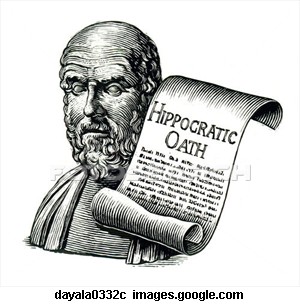
Why Doesn't Every Profession Have a Hippocratic Oath?

I can be sure that you've heard of the Hippocratic Oath, the well known oath that physicians take before becoming doctors.  Why have we only heard of the doctor's oath and not another profession?  Think about how this kind of commitment might change your office or life.  Studies have shown that signing a written code of conduct improve work commitment, quality and integrity.    If your profession had one, what would it look like?

I've included in parenthesis my broad summation/application.  These are subjective and you may disagree.

  • I swear to fulfill, to the best of my ability and judgment, this covenant: (commitment)
  • I will respect the hard-won scientific gains of those physicians in whose steps I walk, and gladly share such knowledge as is mine with those who are to follow. (be a learner and a teacher)
  • I will apply, for the benefit of the sick, all measures [that] are required, avoiding those twin traps of overtreatment and therapeutic nihilism. (altruistic intent, balanced approach)
  • I will remember that there is art to medicine as well as science, and that warmth, sympathy, and understanding may outweigh the surgeon's knife or the chemist's drug.  ('How' and not just 'what')
  • I will not be ashamed to say "I know not," nor will I fail to call in my colleagues when the skills of another are needed for a patient's recovery.  (willing to ask for help, humble)
  • I will respect the privacy of my patients, for their problems are not disclosed to me that the world may know. Most especially must I tread with care in matters of life and death. If it is given me to save a life, all thanks. But it may also be within my power to take a life; this awesome responsibility must be faced with great humbleness and awareness of my own frailty. Above all, I must not play at God.  (Responsible use of information and application)
  • I will remember that I do not treat a fever chart, a cancerous growth, but a sick human being, whose illness may affect the person's family and economic stability. My responsibility includes these related problems, if I am to care adequately for the sick. (Human touch)
  • I will prevent disease whenever I can, for prevention is preferable to cure.  (Be proactive, not reactive)
  • I will remember that I remain a member of society, with special obligations to all my fellow human beings, those sound of mind and body as well as the infirm.  (I'm not just my profession.   I have a larger calling)
  • If I do not violate this oath, may I enjoy life and art, respected while I live and remembered with affection thereafter. May I always act so as to preserve the finest traditions of my calling and may I long experience the joy of healing those who seek my help.  (Keep the goal in mind)
What would your profession's look like?

Sunday, April 18, 2010

What We Really Are--A Scrapbook

You probably only plan on skimming this.  That's okay.  I understand.  I do the same thing and am just appreciative that you're even here.  -But- I'd like to ask that while skimming you let your mind do some calisthenics.  As my (and yours I'm sure) elementary school teacher would say, "Let's put on our thinking caps."  Let the below fill the senses of your mind.

I've heard a biologist say that all birds are really dinosaurs.  In cladistics (the categorization of animals) you really can just put them as a feathered branch of reptiles and more specifically raptors (it's no coincidence that we use the same word to describe birds of prey and velociraptors).  In my mind I was transported to that moment in the movie Jurassic Park when one of the paleontologists saw a dinosaur for the first time.  I can imagine the power of that moment--awestruck that such an organism exists.  It was that wonder and awestruck power that I let fill my mind when thinking about the sparrows outside my building, the penguins of Antarctica, the emus of Australia, the California Condor or just the city side walk pigeons.  Dinosaurs are alive today.  With the wonder filled eyes of that paleontologist we can look outside and see a world where dinosaurs fly by, eat from our bird feeders and crap on our cars all the time.  In fact, I have dinosaur crap on the hood of my Mazda right now.  Amazing!  haha


So, that got me thinking.  What am I?  What are you?  

First, I imagined the people I care about dressed in animal clothing with more pronounced eyebrow ridges, then hunched over, then hairier, then in a tree, then chased into a burrow by a small raptor , then an early mammal ancestor known as a cynodont with slight amounts of sparse hair, then a slick amphibian, then a scaled lobe finned fish, then a jawless fish, then a pseudochordate of some kind, then a protist, then a bacterium, then...

...then a collection of organic molecules that got hit by lightening (or something like that)...

...then a bursting, amorphous nebula created by a super nova--the only thing powerful enough to create the heavier atoms that make up our being...

...then a rewinding video of the expansion of the universe until it collapses into a single mote within a spaceless, timeless, formless void...

So, what are we?  We are a Scrapbook of Evolution

  • We have body hair--clearly mammal.
  • Four appendages--that came from our amphibian ancestors, same with five fingers--four appendages makes sense, but five is moderately arbitrary.  We could have three fingers or a claw.
  • Our ribs--the remnants of the first rudimentary iterative body structures.
  • Our spinal chord--a revolution in biological information superhighway.
  • Our brain localized in our head--got that from the early cephalized ancestors.  Made reaction time quicker, more efficient.
  • Our eyes--once nothing more than light perceiving specks that got deeper to perceive directionality, then form, then color, etc.
  • Our jaw--from the first jawed fish.  We could have beak with five radiations like an urchin if evolution had gone otherwise, but it didn't thanks to that early fish that's 'rib' turned into a jaw.
  • Our teeth--were the first mineralized 'bone' to form in early fish.  We can thank our teeth for the rest of our skeleton.
  • Our nose was once dead end olfactory pits that ended up connecting to the larynx--a much better solution than our lungfish like ancestors that gulped.
  • Our ears are modified gill slits--think about that one.  That's why our ear has a eustachian tube--at one time that's how our ancestors 'breathed'.
We are:

Historically--the culmination of thousands of millions of years of natural selection.
Biologically--an interdependent web of specialists on the body level and at the cell level.
Chemically--a symphony and dance of molecular reactions.
Physically--a servant of the Four Fundamental Forces (strong force, weak force, electro-magnetism, gravity)--a child of the singularity.

What eyes science can give you to see majesty in the mundane, beauty in the banal, transcendence in the trivial!