
Sunday, August 18, 2013


Sunday, July 21, 2013
Why are there two tides a day?
Think about it. Shouldn't there just be one tide on the side facing the Moon? Counter to what we expect, there is a high tide on the side of Earth facing the Moon -and- a high tide on the opposite side. Why is that? Well, explanations abound and many of them are rife with misconceptions. It's been said that the high tide on the opposite side of the Moon is caused by centrifugal motion since the moon is large enough and close enough that the center of mass between the two off sets the Earth's rotation (think of a binary star system--they really orbit each other). Another common explanation is that the moon pulls the Earth away from the water on the opposite side of the Earth, bunching it up together.
The real explanation, as best I understand, is that almost the entirety of the effect is due to gravity (although, I imagine multiple causes are at play). The diagram illustrates. On the side closest to the moon, there are two main gravities pulling--the Earth pulling towards its center of mass, and the moon pulling towards itself. The net effect is a well of water. On the top and bottom (and right angle sides) of Earth the two gravity effects are the Earth pulling down and the Moon's gravity pulling the water towards the high tide. This effect causes low tide. On the opposite side of Earth from the Moon, the two gravity pulls of Earth and Moon are working in concert to cause the water to slightly bunch up. Add this effect to the fact that low tides exaggerate the appearance of high tides and we now have two high tides a day.
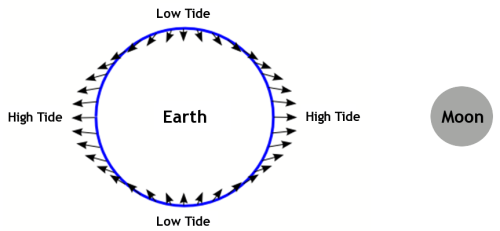
http://www.lhup.edu/~dsimanek/scenario/tides.htm
*Please send additional resources. I am open to debate and correction.
*Please send additional resources. I am open to debate and correction.
Sunday, September 2, 2012
Bubbles Don't Float


Sunday, July 1, 2012
Evolution is Just a Theory - Theory vs. Law
The focus should not be between whether or not evolution is a theory or a law, as in, "I'll take evolution seriously when to goes from a theory to a law." Instead the debate should be between the theory of evolution going from a theory to a disproven theory. The distinction is important and I'd like to briefly outline why.
The usage of the word 'theory' in science is quite distinct from our normal, vernacular usage. In science, the term means 'model' or 'explanation' that incorporates a vast body of knowledge.
Other 'theories' that demonstrate the usage of the word 'theory' in science: cell theory (that tissue is made up of cells), germ theory (diseases and colds are caused by microscopic bacteria, protists and viruses), atomic theory (matter is composed of atoms), theory of gravity (the force of gravity is the explanation for the orbit of stars, planets, galaxies and objects to the Earth), theory of heliocentrism (the Sun is the center of the solar system).
This confusion is the source of some fun internet memes:

A scientific 'law' is not an explanation or model, like a theory, it's a simple statement of this does that. Newton's laws are a go to example--"A body in motion will stay in motion unless acted upon by an outside force". It offers no explanation like a 'theory' would, only a relationship--this does that. If we were to write that law as a theory we'd have to offer some explanation as to *why* it happened that way--something about mass, inertia, Higgs-Bosons, etc.
So in conclusion, the Theory of Evolution could *never* become a law because it could never stop being an explanation as to why biology looks the way it does today. That said, it could become something else--a disproven theory. All it would take for the theory of evolution to be disproven is one fossil, one organism, one anatomical structure, one DNA sequence, one piece of evidence that could definitely disprove common ancestry of life. It shouldn't be shocking that the Theory of Evolution has never become a law, but it should be unbelievably shocking that the theory has never been disproven. The Theory of Evolution has been under constant fire from day one 150 years ago and it has never once shown a sign of weakening. It has only gotten stronger as more evidence has been produced.
The usage of the word 'theory' in science is quite distinct from our normal, vernacular usage. In science, the term means 'model' or 'explanation' that incorporates a vast body of knowledge.
Other 'theories' that demonstrate the usage of the word 'theory' in science: cell theory (that tissue is made up of cells), germ theory (diseases and colds are caused by microscopic bacteria, protists and viruses), atomic theory (matter is composed of atoms), theory of gravity (the force of gravity is the explanation for the orbit of stars, planets, galaxies and objects to the Earth), theory of heliocentrism (the Sun is the center of the solar system).
This confusion is the source of some fun internet memes:

A scientific 'law' is not an explanation or model, like a theory, it's a simple statement of this does that. Newton's laws are a go to example--"A body in motion will stay in motion unless acted upon by an outside force". It offers no explanation like a 'theory' would, only a relationship--this does that. If we were to write that law as a theory we'd have to offer some explanation as to *why* it happened that way--something about mass, inertia, Higgs-Bosons, etc.
So in conclusion, the Theory of Evolution could *never* become a law because it could never stop being an explanation as to why biology looks the way it does today. That said, it could become something else--a disproven theory. All it would take for the theory of evolution to be disproven is one fossil, one organism, one anatomical structure, one DNA sequence, one piece of evidence that could definitely disprove common ancestry of life. It shouldn't be shocking that the Theory of Evolution has never become a law, but it should be unbelievably shocking that the theory has never been disproven. The Theory of Evolution has been under constant fire from day one 150 years ago and it has never once shown a sign of weakening. It has only gotten stronger as more evidence has been produced.
Subscribe to:
Posts (Atom)