
- Neural Impulses
- From .1-100 m/s
- Muscle position nerves--119 m/s
- Pain--0.62 m/s
- Touch--76.2 m/s
- Thought--25 m/s
- Speeds are affected by...
- Temperature
- Warm blooded animals are faster
- Pathway width (axon size)
- Wider is better
- Giant squids living in the arctic have huge pathways (axons) to make up for the cold temperature and having no insulation (myelin sheathing).
- Insulation (myelin sheathing)
- Vertebrates have insulated nerves and therefore way faster impulses
- Quite a difference is made--1 m/s (inverts) vs 100 m/s (verts)


- Muscle Twitching
- Fastest: Eye twitching at 7.5 msecs (milliseconds or 1/1000th of a second)
- Calf muscle--100 msecs


- Reflexes
- Fastest: vestibulo-ocular reflex (The rotation of your eyes correcting for head tilt. You can witness this by looking in the mirror and cocking your head to the side and noticing how your eyes maintain vertical position.). There are only three neurons in the whole system and the whole process takes 1/100th of a second to correct.
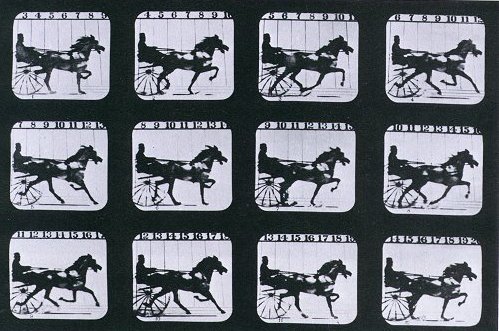
- Sight
- We can notice moving image frames slower than 1/16th of a second.
- Most movies are 24 to 48 frames per second

- Cell division
- Some bacteria can divide as quickly as once every 9.8 minutes
- DNA Translation
- The RNA polymerase can add 50 base pairs per second

- Hearing
- The timing difference between sounds reaching ears is known as the interaural time difference. It's important in determining which direction a sound comes from.
- This difference is maximally 660 microseconds (660 millionths of a second) when the sound is at a right angle to the front of the face.
Works sighted [sic]:
http://cwx.prenhall.com/bookbind/pubbooks/martinidemo/chapter10/medialib/CH10/html/ch10_5_1.html
http://www.biologymad.com/NervousSystem/nerveimpulses.htm
http://www.funtrivia.com/askft/Question82039.html
http://en.wikipedia.org/wiki/Vestibulo-ocular_reflex#Speed
http://news.softpedia.com/news/The-Fastest-Muscles-83834.shtml
http://en.wikipedia.org/wiki/Persistence_of_vision
http://www.ncbi.nlm.nih.gov/pmc/articles/PMC2064748/
http://en.wikipedia.org/wiki/Interaural_time_difference
http://www.ncbi.nlm.nih.gov/pmc/articles/PMC279347/?tool=pmcentrez
http://www.dnareplication.info/speedofdnareplication.php


