I had a friend recently say that, "Creativity is the combining of ideas in a new way." (Jamie Riley paraphrase) I think he's on to something there. Creativity is the game "Apples to Apples"--making new connections between disparate ideas.
What I'd like to do is consider how two ideas--meditation and science literacy--might intersect. Let me give a greenhorn's understanding of some meditation practices and then discuss how science can fit hand in glove with your own practice of meditation.
First, a story on how meditation saved my butt!!!
I was at a local meditation event listening to a guided meditation and my mind unprompted went where it often goes in these situations--to imagining the invisible electro-magnetic/atomic world around me. I was imagining the atoms around the room bustle in Brownian motion, interact with photons, change quantum states, vibrate synchronistically through sound, circulate around the room in zyphers of wind and conviction currents, etc...and...suddenly...O SH%#!!! I forgot to turn off a heating plate at my job at a chemistry lab!!! Luckily I was able to call over and have it turned off, but I was so scared since I had it on for a few hours!! Yikes! Meditation saved my butt! haha!
Ok, back to an over view of meditation so we can see how science meditation can fit in!
Types of meditations (as I understand it)
"The desire to be connected with the cosmos reflects a profound reality--we are connected; not in the trivial ways that Astrology promises, but in the deepest ways." --Carl Sagan
Later note: There are two main kinds of meditation--focused attention and open monitoring. Focused attention finds holds an object in conscious attention. Open monitoring allows the mind and senses to wander, allowing thoughts and perceptions to come and go as they will. Open monitoring with science might include being in nature and simply soaking up the sounds, sights, smells, and sensations.
What I'd like to do is consider how two ideas--meditation and science literacy--might intersect. Let me give a greenhorn's understanding of some meditation practices and then discuss how science can fit hand in glove with your own practice of meditation.
First, a story on how meditation saved my butt!!!
I was at a local meditation event listening to a guided meditation and my mind unprompted went where it often goes in these situations--to imagining the invisible electro-magnetic/atomic world around me. I was imagining the atoms around the room bustle in Brownian motion, interact with photons, change quantum states, vibrate synchronistically through sound, circulate around the room in zyphers of wind and conviction currents, etc...and...suddenly...O SH%#!!! I forgot to turn off a heating plate at my job at a chemistry lab!!! Luckily I was able to call over and have it turned off, but I was so scared since I had it on for a few hours!! Yikes! Meditation saved my butt! haha!
Ok, back to an over view of meditation so we can see how science meditation can fit in!
Types of meditations (as I understand it)
- Mind Scape Meditation
- Idea/mantra
- Focusing deeply on a central thought. Learning about it. Thinking through it. Applying it. Making it real within your mind. Reveling in it.
- Person
- Meditate on a person you truly admire. Why do you admire them? What can you learn from them? How can you honor their lives with your life?
- Object
- Symbolism
- Essence
- Function
- Feeling
- Become self aware. Not necessarily judging what you're mind is feeling, just only observing, analyzing. Becoming mindful of your brain--the vast expanse of neural experiences within.
- Problem solving
- Taking time to work through a problem--reviewing past actions, considering future options.
- Thankfulness
- Counting one's blessings.
- Bodyscape
- Become aware of your body
- What is your body feeling? Pain? Boredom? Fatigue? Why? Analyze, don't judge.
- Motion
- Walk
- Be mindful of the motion, the muscles, the action, the intention.
- Surroundings
- Become aware of your senses.
- What sounds do you hear around you? See? Feel?
- For a challenge, see if you can observe more than one occurrence at a time. Can you do three? It's supposed to not really be possible to pay attention to three things with any real level of depth.
- Mind
- Consider the crackle of electric impulses within your mind--100 billion neurons buzzing, humming, communicating, resting, their amoeboid arms stretching out to form connections totaling 100 trillion
- Consider the micro ocean of neurotransmitters chemically setting into motion the thoughts, sensation and actions of the body--just slight parts per billion that manifest huges changes
- Body
- Go from head to toe considering all the functions that are taking place in your body
- Blood
- Red blood cell oxygenation
- White blood cells capturing invaders and consuming dead or defunct cells
- Heart and its molecular muscle motors reacting to the power of ATP
- Lungs filling, oxygenating, dispursing CO2
- Liver, kidneys, pancreas, gall bladder, intestines, muscles and on and on!!!
- Surroundings
- Consider sound. Become mindful of the sources of the sounds around you. Consider the waves emanating from the source--the compression pulses of wave in the form of concentric circles growing larger and then reflecting and bouncing off the other objects in the wall. Much like a 3-D version of the surface of a pool of water that has been disturbed. Become aware of how that sound hits the curves and bowl of your ear, traveling down your ear canal to the ear drum, the three ear bones, the inner ear, the cochlea, the fluid and hairs within the cochlea, the impulses traveling from ear to brain, etc.
- The Electromagnetic world around you
- The process of seeing
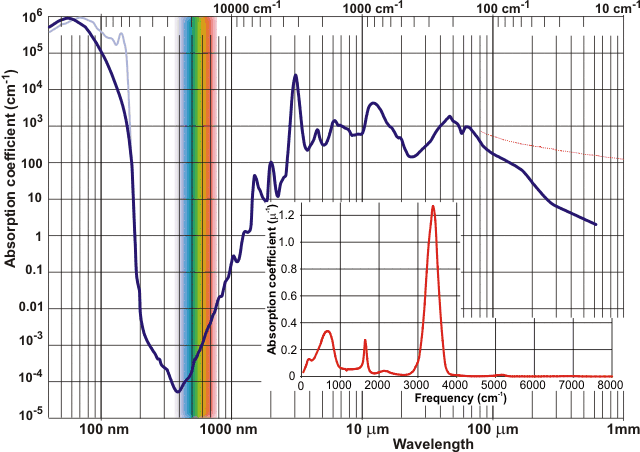
- The invisible spectrum
I have benefited greatly from these lectures by Dr. Feynman and really do hope you'll click on this link if for no other reason that to see that they exist. Feynman has a brilliant way of bringing the invisible reality to life.: http://www.youtube.com/results?search_query=richard+feynman+fun+to+imagine&aq=f
- Neutrinos
- There are billions of neutrinos flowing through our body every second flowing from the Sun.
- Geographic location
- Consider the forces that created the land around you. Reverse, in your mind, time to undo the weathering forces, plate tectonics, igneous forces, etc.
- Elemental history
- Consider the history of the elements around you. Their age in billions of years. Their star ancestry.
- Evolution
- If you're walking, consider an animal. In your mind go through their evolution history, the epochs, bio-geography, the predators and prey its ancestors encountered.
- Solar Power
- Become mindful of how a seething ball of magnetized gas 93 million miles away is heating itself to astronomical degrees--27 million in the core-- by the crush of gravity as new heavier elements are created and releasing prodigious amounts of energy. Electron motion becomes wavicle photons that travel through a void of space to a spinning ball held in rotation by the gravitational bending of space time. This energy causes photosynesis, which powers plants, which power the animals we see and ourselves. Everything is solar powered.
- Space
- See through the Earth and the physical features around you. See in your minds eye the position of the Sun, the moon, the stars through the atmosphere and through the Earth. See the core of the Earth, the upside down walking of people on the other side of the Earth, consider the distances of how far they are, imagine birds flying upside down, water being pulled "up", kangaroos hopping upside down in Ausatralia, the thousands of people in the air in planes being ferried from place to place, etc.
So, why bother? Why spend the time? Why expend the energy?
To me that's almost like asking, "Why love?" To connect. To realize. To become one. To stretch. To unbound yourself.
Later note: There are two main kinds of meditation--focused attention and open monitoring. Focused attention finds holds an object in conscious attention. Open monitoring allows the mind and senses to wander, allowing thoughts and perceptions to come and go as they will. Open monitoring with science might include being in nature and simply soaking up the sounds, sights, smells, and sensations.