Showing posts with label fish. Show all posts

Sunday, September 12, 2010

Blind Cave/Subterranean Dwellers - Ancestor's Resemblance

Enjoy the pix!


This guy above has these gel covered 'hairs' that are super sensitive to movement allowing it to 'see' the surroundings via vibrations.


See!  The eye sockets are still there, but they don't do anything!!
I just thought these below were interesting.  They're the skulls of blind snakes.  As an aside, I was lucky enough to see a blind snake in Namibia when I was curious enough to turn over the right rock.


Olm
Texas blind salamander
Kauai cave wolf spider 
Here's the conclusion: blind cave/subterranean dwellers are marvelous examples of evolution in that they show history.  We are all descendants of a common ancestor and the evidence of our evolutionary history is on and in every part of us.  Just like you resemble your parents, so do these examples resemble their millions of years ago ancestors who had eyes that worked.  Some of them even have some new tricks up their sleeves, like the ones with motion sensor hairs.

Sunday, July 18, 2010

How Do Lake Species Spread?


How is it that there are freshwater fish species that naturally (barring human influence) have a distribution that stretches thousands of miles across the United States?  

Draw your eyes to the diagram to the right.  Not only because of the expanse of the natural distribution of largemouth bass (light green), but also of the ability for sport fishermen to spread a species quite easily (dark green).  (also, as an aside, observe the wonderful shadow effect of the distribution of the largemouth bass that couldn't make it over the Appalachians!) 

So, let's start a list and please, please add to it so that we can understand how freshwater imprisoned species can make jail breaks and spread to other regions.

Piggy Back Rides - let's go with the simplest explanation first - they hitchhiked.  This may seem far fetched, and it is, but we are going to have to not rule out some quite far fetched ideas if we're ever going to explain the far fetched true nature of the reality presented to us  came to be (i.e., that species are where you might not think they should be).  Think of the moist caverns of a alligators jaw, or a nooks of a turtle's plastron and body, or perhaps the fur of an otter, beaver or other aquatic animal. or, who knows, maybe even the inside hook of an osprey/bald eagle's claw...extremely unlikely for almost all of them, but it's a brainstorming thought...


Hurricanes- and by hurricanes I actually also mean all major storms and floods (they're just the most dramatic).  If I didn't come from Florida this would seem much more far fetched.  In bio-geography you hear some strange stories.  Think of the Galapagos.  How the hell did tortoises swim to an island 650 miles from South America?  Seriously, how?  Same goes for the iguanas there.  How did the monkeys that now populate South America make their way from Africa?  How did the Giant Sloth reach North America?   How were any of the Caribbean islands populated with any of their mammal or reptilian fauna?  They rafted over.  That should amaze you.  It really should.  And, we can thank hurricanes and typhoons for a great majority of the DNA/species churning of the world.  I've seen many mighty trees felled in Florida by hurricanes and it isn't too unreasonable to see stow-aways clinging to these during times of a tumultuous tempest.  While the examples I've given are for terrestrial animals, the principle is the same - massive, devastating weather systems mix the biological cauldron of life.  Floods spill species. 


Zephyrs - This clearly has limited application, but it by far the most interesting to me.  Did you know that there are species of rotifers (a water bound species) that can desiccate themselves and go air born to spread?  That's ridiculous!  Not only that, but that can help to explain how they've managed to asexually divide for millions of years and not have completely mutated themselves out of existence (which, is the fate and demise of most asexual reproducers).  When they dry out their DNA gets shattered, which makes it possible for when they are rehydrated to fuse with other DNA from other living organisms and sometimes, chance against chance, evolve effectively this way.  (see http://scienceblogs.com/notrocketscience/2010/01/rotifers_find_answer_to_parasites_by_blowing_on_the_wind.php for more info)


So, what else?  How can fish walk?  

Monday, June 28, 2010

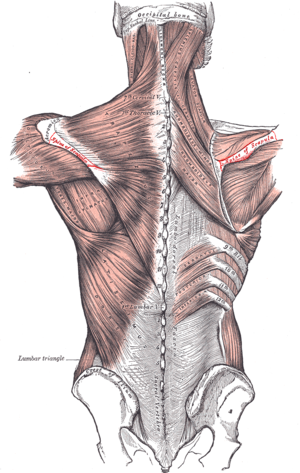
Scapula - Why Do We Have 'Wings'?

Ever wonder why we have little bone 'wings' on our back?  

Evolutionary history:
Present in fish in multiple arrangements, often multiple bones, often both on the dorsal and ventral sides.  All other vertebrates seem to have them, too (at least in some fashion).  Early mammals, starting with therapsids, seem to have undergone a fusion of the separate bones that there used to be (monotremes like platypuses and echidnas still retain an earlier multi-bone structure).

Function:
The biggest purpose is that in conjunction with the clavical it gives grounding to the arm and, more specifically, acts as the rotator cup of the arm.
It also helps to deal with the fact that we're ovals.  How do you attach linear muscles to a round object?  Break up the distance.
Secondly, how do you deal with a joint that needs to articulate back, but also down?  As in, imagine if we didn't have a scapula and our shoulder muscles simply attached to our spine.  Pulling back (like opening a door) and pulling down (like doing a pull-up) wouldn't be as distinguishable.  The arm would just go back (but not down).

It's important to think about what the scapula tells us about our evolutionary history.  Why don't we have a clavical set up like on our chest on our back?  I.e., why not a joint stabilizing bone, but attach all our muscles to the middle (sternum or spine)?  Well, because we used to run with our arms, because we used to climb and both those require some serious power and specificity.

Interesting to think about...

Well, anyway.  We're a visual species.  Here's some eye candy.


Raccoon
 
Mammoth
Brachiosaurus