Showing posts with label hemoglobin. Show all posts

Sunday, February 6, 2011

Bloods

"For the life of the flesh is in the blood." Leviticus 17:11

There's an extraordinary variety of life giving blood in the world.  Enjoy!

Blue Blood: our blood, of course, is red because of iron.  Many insects, crustaceans, arthropods and mollusks use a different metal to cause oxygen to be reversibly bound - copper called hemocyanin (these proteins with metal in them are cleverly known as metalloproteins).  When unoxygenated, it's a boring grayish, but pepper it up with some oxygen and things get an exciting blue/green.

This hue is apparently from hemocyanin (copper/blue blood)
Anucleated: so, I knew that our human blood cells didn't have nucleuses, but what I did not know is that we're the exception and not the rule.  Almost all other vertebrates aside from mammals (more on exceptions later) have red blood cells that contain nuclei.  So, why have mammals evolved an awesome mechanism to expunge their nucleus at the right moment of red blood cell development (which I'd totally love to know more about that mechanism.  Please post if you know)?  Well, it kind of just takes up space.  The one and only job of red blood cells is to transport oxygen (to other cells) and carbon dioxide (away from cells) and anything else is just a waste.  Having small red blood cells also makes small capillaries possible which can mean much better diffusion of gases.  Since nothing's perfect the downside to this method of making red blood cells is that they have a limited ability to repair and create energy (since they have no DNA nor mitochondria).


Blood Without Blood Cells: It's kind of like bloodless blood or blood lite, but it's a way of saving metabolic energy.  There are certain circumstances that are oxygenated  enough that the organism doesn't need the help that blood cells provide (either hemoglobin or hemocyanin).  Many insects are small enough that diffusion through their spiracles (kind of like body vents) does the trick.  Another AMAZING exception is the crocodile icefish of the Antarctic waters.  It's so cold and the water is so oxygenated that it simply doesn't need red blood cells and simply has clear blood.  That's awesome!!!  The other exciting thing is that we can sequence the genome of these fish and see that the genes for red blood cells are there, but mutated.  Go evolution!

Crocodile Icefish
Vanadium Filled Blood: first you should know that Vanadium is a very rare element, hence probably why you don't know crap about it (much like me).  Tunicates and some sea cucumber have high concentrations of vanadium - as high as 1 million times that of the sea water around them.  Hypotheses vary on what it may be good for - toxin, oxygen transporter or other.

Some sea squirts/tunicates are pretty!


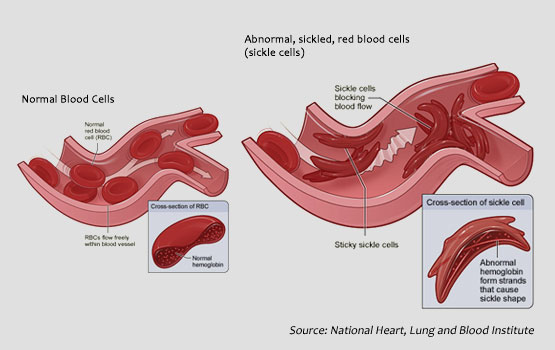
Deformed Red Blood Cells: yes, you've heard of sickle cell anemia and know that it's bad because the red blood cells aren't as flexible as they need to be (since capillaries are 25% smaller than red blood cells and they have to squeeze through) and they can get clogged.  You probably also know that it's a defense advantage for dealing with malaria.  One of the reasons is that cells with the sickle mutation look normal until they have low oxygen levels and then they change into the abnormal shape (that's why flying can be dangerous for people with sickle cell anemia).  If a cell is infected with plasmodium (the protist that causes malaria) its oxygen level drops, it then turns sickle shaped and is subsequently consumed by white blood cells - malaria's gone! Unusual shapes like fusiform, lanceolate, crescentic, and irregularly polygonal can also be seen in the elk of North America and their counterpart, the red deer of Europe. I couldn't find why, but I would bet good money this is another parasite defense since the draw backs to these shapes can be severe (ask any person with sickle-cell anemia).


Anucleated Amphibian Blood: as we've said earlier, amphibians almost always have red blood cells that have nuclei.  There's an exception and one that makes sense - some lungless salamanders.  Let's say you're a salamander and here's your problem: you've evolved away your lungs because you're small enough to not need them, but then you need to evolve to be bigger again or to be more active.  How do you do it?  Make your blood more efficient and ditch the nuclei of your red blood cells!

http://en.wikipedia.org/wiki/File:Kaldari_Batrachoseps_attenuatus_01.jpg
Amoebyctes/hemocytes: just think about that there are amoeba like white blood cells crawling around in your body right now.  Then think about that that's these amoebycte blood is the only kind of blood some invertebrates have!  Check it out!


Saturday, January 29, 2011

Why Pee Is Yellow, Poo Is Brown and Bird Crap Is White

I feel like I struck question gold on this (no urine pun intended).  What's most awesome about the answer to this question is that it involves a whole slew of major organ systems in  your body.  On to the details!


When old blood cells retire the hemoglobin in them gets broken down into bilirubin.  This is no small thing.  You have 30 trillion red blood cells in your body and each of those cells has 270 million hemoglobin molecules in it.  Just to be able to have a stable red blood cell count and compensate for loss you have to make 2.7 million red blood cells a second!!   Bilirubin is also the yellow substance that causes bruises to appear yellow, as well as the yellow pallor of jaundice. 


I thought this was interesting.  It's all about moving oxygen and electrons!

Notice how it basically just loses the iron and gets splayed out.


This worn out hemoglobin gets disposed of in two places. One is our liver.  The liver is a thrifty organ and filters bilirubin out of the blood, concentrating it in the gall bladder as one of the main constituents in bile ('Bile' and the first half of 'bilirubin' come from the same Latin root meaning 'anger', 'wrath', or 'gall'.  'Rubin' means red, so literally it means 'red wrath'.).  Bile is squirted into our G.I. tract and does a great job emulsifying fats for us to process.  You may know someone that has had a gall stone and suffered from the symptom of intense pain after eating fatty foods.  Their body is trying to pump out bile to break down the fats, but is being painfully blocked.  If a severe enough condition exists, gall bladder removal surgery may be prescribed, in which case the patient will have to eat a low fat diet (or deal in other ways) since high fat content without a means of processing the fats can cause serious indigestion and bloating. Assuming proper function, the bilirubin in bile gets further broken down by bacteria in the gut into a brown substance called urobiligen, which is the main reason our feces is brown.


The liver, however, doesn't catch all of the bilirubin floating through the blood stream and the excess gets mopped up by the kidneys to be disposed of.  Before leaving the body it's further broken down into urobilin, which, you guessed it, is yellow.  So, no, it's not urea that makes our urine yellow.  Urea is colorless.

***Be really careful with this photo.  Those colors are for distinguishing them ONLY.  Not true colors.

Review:

Hemoglobin in blood breaks down into bilirubin which is filtered out by A) liver or B) kidney

A) Our liver concentrates it in the gallbladder as bile, which then pumps it into the intestines and is broken down by bacteria into the brown we know our feces as.

B) Our kidney further breaks bilirubin down into urobilin which is yellow and excreted in our urine.

From blood to Liver to Gallbladder to Intestines to Poo.

Blood to Kidneys to Wee.

Red (of blood) to Green (of bile) to Brown (of poo).


Red (of blood) to Yellow (of wee).

So, the next time you use the ole water closet, remember that your pee is yellow and your poo brown because it's broken down blood!!

Amazing ways evolution has made things look like bird sh*t:


Now, bird crap's a whole different story.  When amino acids, the building blocks of proteins, break down (for a number of reasons, like they were digested but not used by the body or just as the wearing out of protein) they can turn into urea directly or its nastier cousin ammonia which is quickly broken down by the kidneys into the safer urea.  Well, that's how it goes if you're a mammal, anyway.   Birds and reptiles do things a  little more complicated for two reasons.  One is to save water.  Urea is water soluble and therefore needs to be flushed out with large quantities of water in order to be disposed of.  This means, as mammals, we're constantly throwing away a relatively large amount of perfectly good water in order to get rid of urea.  Birds and reptiles solve this problem by expending a little more metabolic energy and turning broken down amino acids into uric acid which is relatively insoluble and can be concentrated as the white precipitate paste we see in bird poo (often mixed with brown since they poo/wee out of the same orifice and usually at the same time).


The other more interesting reason is to solve an egg problem.  When a fetus in utero makes waste, the mommy is nice enough to dispose of the babies waste through the placenta.  If you are a species that is isolated in eggs urine trouble! (Get it?  Get it?...)  They have to isolate their waste so it doesn't poison the entire egg.  One of the most effective ways of doing this is to make it mostly insoluble in water so it can't spread - make it into uric acid.  Genius.


It's interesting to note some exceptions.  Some turtles start off making uric acid while  in the egg to get its largely insoluble advantage, but then later in life switch to urea (like us) since it takes less metabolic energy to make (I assume the same is true for egg laying mammals like platypuses and echidnas which do use urea later in life).  The kangaroo rat, even though it's a mammal, is another exception that has evolved to survive in a harsh desert environment by using the water conserving uric acid method of amino acid disposal.

I hope you never think of using the bathroom the same!


Works Sighted [sic]:


Pictures from here, here, here, here, herehere, here, here, here, here, here, here, here, here, here, here, here and here.