Let's let our bodies speak and tell us what diet we should eat - Evolution's Fad Diet.
We have a relatively small large intestine (in comparison to other animals), which are used to house bacteria to ferment foliage (among other stuff). That probably means that we didn't eat a whole lot of salads. In the book Before the Dawn one of the most surprising things I read was that during the Ice Age humans probably only ate about a cup of greens a year! (Based on bone/tooth composition, which contains molecular markers for what they ate) Don't take that too far. We do have a significantly sized lower GI.


We have relatively small guts. That means our diet has been relatively high quality for a while - meats, fats, carbs from things like tubers, cooked matter.
We don't synthesize Vitamin C. Our relatives did, though. The section of our genome that used to has been identified, but it's garbled through mutation and since our diet usually had enough Vitamin C (most likely from fruit) we lost the ability.

Our appendixes are all but gone. We don't need them to break down cellulose (plant pulp) anymore.
Many humans digest lactose after infancy which means being able to drink milk had a very significant selective advantage (since it's so freaking recent - less than 10k years). Places like the Netherlands which have traditionally farmed cows have lactose tolerance rates nearing 100% (certain pastoral African tribes have comparable rates).

We have small teeth and weak jaw muscles. This is probably due to an increase in caloric quality of diet (carbs, fats, proteins) and the advent of cooking (which goes back several million years).

.gif)
Our teeth or flatter and better for grinding in comparison to other primates which have teeth so jagged that they can't grind.

We don't synthesize all the amino acids necessary for life. Where doest the term 'essential' in 'essential amino acids' come from? Essential to all life? No. Only essential to humans. Think about it. We have to eat all the essential amino acids or we get quite sick, but other animals don't worry about it. You don't see cows munching soy, yeast, rice with beans, meat, etc. Their hulking lumps of bovine bodies make them quite well on their own.

Related topic:
Subcutaneous fat: some argue that humans have much more subcutaneous fat than other primates (subcutaneous is right below the skin as opposed to the internal types of fats). Contrawise, others say nay and point to domesticated and caged animals as pudgy examples. A greater need for subcutaneous fat could come from: variability in diet availability, aesthetic look of fat distribution (think booty and breasts, which are largely lumps of fat), or thermal protection during Ice Ages accompanied by a lack of body hair.

We have a relatively small large intestine (in comparison to other animals), which are used to house bacteria to ferment foliage (among other stuff). That probably means that we didn't eat a whole lot of salads. In the book Before the Dawn one of the most surprising things I read was that during the Ice Age humans probably only ate about a cup of greens a year! (Based on bone/tooth composition, which contains molecular markers for what they ate) Don't take that too far. We do have a significantly sized lower GI.

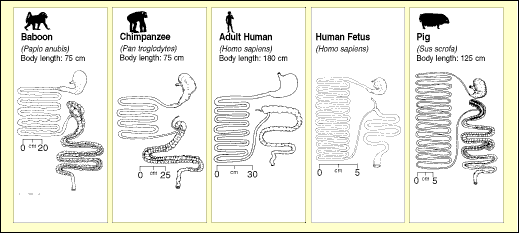
We have relatively small guts. That means our diet has been relatively high quality for a while - meats, fats, carbs from things like tubers, cooked matter.
 |
| No, that gorilla's not preggers. They just have massive guts to break down the difficult to digest foliage they munch on. |
We don't synthesize Vitamin C. Our relatives did, though. The section of our genome that used to has been identified, but it's garbled through mutation and since our diet usually had enough Vitamin C (most likely from fruit) we lost the ability.
Our appendixes are all but gone. We don't need them to break down cellulose (plant pulp) anymore.
 |
| The cecal appendix (a through l) or appendix-like structures (m through o) in a variety of mammals. The cecum ⁄ appendix is oriented toward the top of each drawing, the distal end of the small intestine toward the left and the proximal end of the large intestine toward the bottom. (a) human, Homo sapiens; (b) Pongo pygmaeus, orangutan; (c) Lepilemur leucopus, sportive lemur; (d) Lasiorhinus latifrons, Southern hairy-nosed wombat; (e) Oryctolagus cuniculus, rabbit; (f) Phalanger gymnotis, ground cuscus; (g) Anomalurus derbianus, scaly-tailed flying squirrel; (h) Trichosurus vulpecula, common brushtail possum; (i) Bathyergus suillus, Cape dune mole-rat; (j) Atherurus africanus, brush-tailed porcupine; (k) Castor canadensis, beaver; (l) Microtus pennsylvanicus, meadow vole, shown with a partially uncoiled large bowel; (m) Phascolarctos cinereus, koala; (n) Ornithorhynchus anatinus, platypus; (o) Tachyglossus aculeatus, echidna. http://scienceblogs.com/pharyngula/2009/08/evolution_of_the_appendix.php |
Many humans digest lactose after infancy which means being able to drink milk had a very significant selective advantage (since it's so freaking recent - less than 10k years). Places like the Netherlands which have traditionally farmed cows have lactose tolerance rates nearing 100% (certain pastoral African tribes have comparable rates).
 |
| Lactose intolerance distribution |

We have small teeth and weak jaw muscles. This is probably due to an increase in caloric quality of diet (carbs, fats, proteins) and the advent of cooking (which goes back several million years).

.gif)
Our teeth or flatter and better for grinding in comparison to other primates which have teeth so jagged that they can't grind.
.jpg) |
| Pan=chimp, Pongo=orangutan |

We don't synthesize all the amino acids necessary for life. Where doest the term 'essential' in 'essential amino acids' come from? Essential to all life? No. Only essential to humans. Think about it. We have to eat all the essential amino acids or we get quite sick, but other animals don't worry about it. You don't see cows munching soy, yeast, rice with beans, meat, etc. Their hulking lumps of bovine bodies make them quite well on their own.

Related topic:
Subcutaneous fat: some argue that humans have much more subcutaneous fat than other primates (subcutaneous is right below the skin as opposed to the internal types of fats). Contrawise, others say nay and point to domesticated and caged animals as pudgy examples. A greater need for subcutaneous fat could come from: variability in diet availability, aesthetic look of fat distribution (think booty and breasts, which are largely lumps of fat), or thermal protection during Ice Ages accompanied by a lack of body hair.

Post script:
Our bodies need vitamin B12, which we need from animal products.
Our bodies product elastase, which digest elastin, a connective protein in animal tissue.

