Saturday, May 28, 2011

The Speed of the Small


  • Neural Impulses
    • From .1-100 m/s
      • Muscle position nerves--119 m/s
      • Pain--0.62 m/s
      • Touch--76.2 m/s
      • Thought--25 m/s
    • Speeds are affected by...
      • Temperature
        • Warm blooded animals are faster
      • Pathway width (axon size)
        • Wider is better
          • Giant squids living in the arctic have huge pathways (axons) to make up for the cold temperature and having no insulation (myelin sheathing).
      • Insulation (myelin sheathing)
        • Vertebrates have insulated nerves and therefore way faster impulses
          • Quite a difference is made--1 m/s  (inverts) vs 100 m/s (verts)


    • Muscle Twitching
      • Fastest: Eye twitching at 7.5 msecs (milliseconds or 1/1000th of a second)
      • Calf muscle--100 msecs


    • Reflexes
      • Fastest: vestibulo-ocular reflex (The rotation of your eyes correcting for head tilt.  You can witness this by looking in the mirror and cocking your head to the side and noticing how your eyes maintain vertical position.).  There are only three neurons in the whole system and the whole process takes 1/100th of a second to correct.
    • Sight
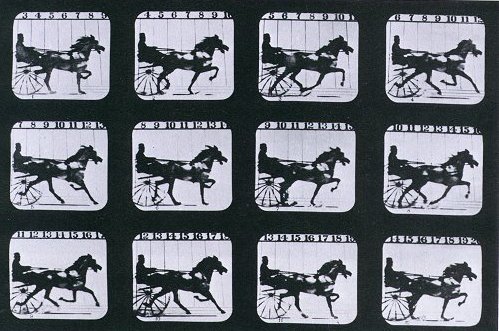
      • We can notice moving image frames slower than 1/16th of a second.
        • Most movies are 24 to 48 frames per second

    • Cell division
      • Some bacteria can divide as quickly as once every 9.8 minutes
    • DNA Translation
      • The RNA polymerase can add 50 base pairs per second

    • Hearing
      • The timing difference between sounds reaching ears is known as the interaural time difference.  It's important in determining which direction a sound comes from.
        • This difference is maximally 660 microseconds (660 millionths of a second) when the sound is at a right angle to the front of the face.

    Pictures from here, here, here, here, here, here, and here.

    Works sighted [sic]:

    Sunday, May 15, 2011

    At the Tank--Sea-to-See Job Notes

    This is part two of a two part series cataloging a portion of what I did with my job at FSU's Sea-to-See which is a program that travels to local elementary schools giving a marine biology presentation replete with touch tanks, interactive activities and video.  Keep in mind it is for kids as young as second grade (it's pretty darn basic stuff and I write it down here mostly to keep for future reference if I ever do something similar again.).  :)  At that age the biggest thing is just to get the kids touching stuff and making observations.


    • Sea Urchins
      • Hold in hand
        • Feel movement of spines and tube feet
        • What are spines for? (Defense)
        • Why do you think urchins put shells etc. on top of them?
          • Some interesting research has shown that it could be for UV protection--much like applying sun tan lotion
          • Other possibilities?   
            • Camouflage
        • Pedicellaria--tiny pinchers to clean bod with.

        • Turn over
          • Find mouth
            • Count how many parts its beak has
            • Notice pentaradial symmetry 
              • Can you find anything else in the tank with five of something?  What do you think that might mean about them?  (Sea star.  They're related.)
            • What do you think it might eat?  (Algae and sea grass.)
        • Where are its eyes?
          • All over!   
            • Concentrated on tips and base of suction cups
            • Ask who wants to be a sea urchin?!  Have kids close eyes, look toward a light source and wave hand above eyes.  A shadow will be cast by hands simulating what it is like to see in only shadows like echinoderms.


      • Sea Stars
        • Pick up
          • Touch top
            • How feel?
            • Sea stars often move in the direction of the arm opposite their madreporite (mother pore) (the trivium arm, as opposed to bivium arms).
          • Flip over
            • What do you think that orange stuff is?  (Tube feet)
              • Touch and watch arm "zip" them up
                • Why? (Protect the delicate tube feet.)
              • Who wants to "be" a sea star with me? (Kids raise hands.)
                • We move by contracting muscle on bones, but the sea star has a very different way of moving--kind of like the exact opposite way!!  Instead of contracting muscles he inflates his arms!!! (Water vascular system)
                • Have kids lift arms above head and retract them all the while making sucking noises (to fill up arms as they extend) and farting/deflating noises (upon contraction)
              • Guess how they breathe--through their feet!  Can you imagine if you breathed through your feet!!?  Wouldn't that stink, literally!!!
              •  They also taste with their feet!!  Imagine tasting your shoes right now!  Or the floor!

              • Can anyone find mouth? (At center of arms.)
                • How might a scientist test to make sure that really was the mouth? (Put some food there and see if it gets eaten.)
                • Discuss how sea star eats by extruding mouth outside of body
                  • Can you imagine eating that way!?  Imagine your lunch table if you were all sea stars and there where slimy stomachs all over the place!


        • Sea Cucumbers
          • Pick up sea cucumber
            • How do we know it's not dead? (Since it totally looks that way!)
              • Kids will eventually say if it moves
            • How many sides does it have?  (Five)
              • What else in the tank has that and what do you think it means?  (Related to the other pentaradials)
            • How do you think it defends itself?
              • No spines, no shell, no pinchers, super slow.  How do you think he protects himself??!
              • Who here likes scary movies?  (Kids love to act tough and say they do.)
              • What you'd do if you were a sea cucumber and you got scared is you'd barf up your guts!!!  Can you imagine if everyone in a movie theater was a sea cucumber and they all got scared and there were guts flying everywhere!!!?!?
              • Why do you think they do that?
                • Maybe because predator loves guts, eats them and gets full--sea cucumber gets away scot-free
                • Or, maybe the guts taste/smell really awful and the predator gets the heck out of there!


              • Pearl Fish
                • There is a whole species of fish that lives no where else but in the butts of sea cucumbers!!
                  • Can you imagine living your entire life in a butt!!?!?!


              • Hermit Crabs
                • See if you can find its two kinds of antennae
                  • Two long for feeling
                  • Two short that he flicks through the water to smell
                  • Who makes a shell a hermit crab or a snail? (Snail.)

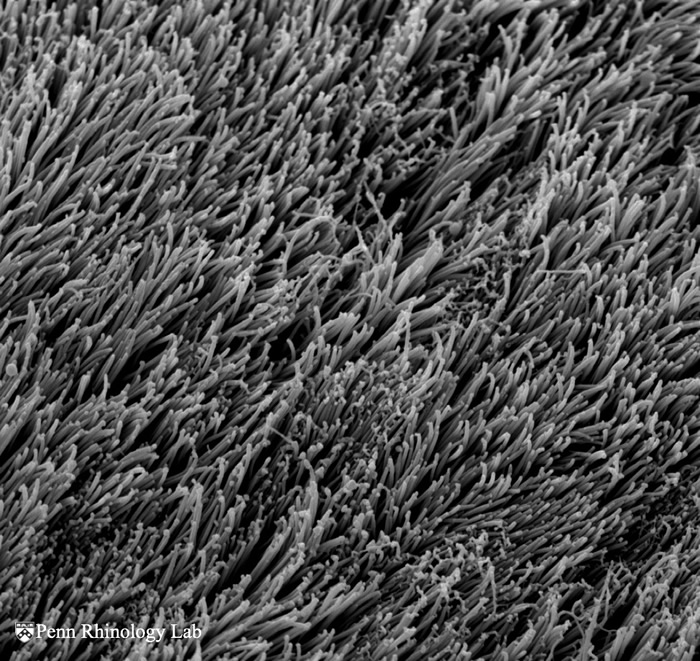
            Antenna 1 (antennule) is used for smelling.  Other electron microscope pic here.


                • Snails
                  • How do they crawl?
                    • Cilia
                      • Tiny hairs that tickle the ground
                      • Did you know that you have the same thing inside your body!!!?!?!  Guess where?!?!?!   In your lungs and trachea!!! 
                  • Where's the oldest part on the shell?
                    • Tip of spire is actually baby shell
                    • Every day they add a little bit more to shell opening's edge and spiral around


              Images from here, here, here, here, here, here, here, here, here, here, and here.

              Sunday, May 8, 2011

              How to Appreciate Other Religions/Political Parties

              This isn't compromising your beliefs.  Keep your beliefs, but learn how to appreciate where others are coming from, too. Even if for no other reason than to understand how to change their mind better!!

                Do you ever feel like you can't bring up the dual conversational unmentionables--politics and religion--without getting frustrated or upset?  Read on then!

              • Finding Common Ground
                • Values
                  • Many times beliefs are different ways of expressing the same values.  It's tragic that we don't realize this enough.  Let me give some examples.  
                    • Healthcare in the US--to definitely and admittedly oversimplify, one group thinks it barbaric to withhold proper medical care to the poor in one of the richest countries in the world.  Why?  Because they care about people.  That's the heart value that drives their beliefs.  The other side doesn't want universal health care because they think it will drastically reduce the quality of the care and further dig America into a debt hole.  Why?  Because they care about people.  Same value.  Different application.  Different way of serving that value.
                    • How about another extremely heated topic--abortion?  One side says abortion is wrong and their value is that human life (the baby's) is precious.  The other says abortion is morally permissible because life (the mother's) is precious.  Each can say one side is mistaken or deluded, but it helps me to avoid vilification to understand what value is driving the person's belief and often how drastically similar they are to mine--trying to protect a life. 
                    • Remember to remember why people are passionate about causes--they care!  They really love something!                                                                                                                                                                                                                                                                                                                                                                                                                                                                                                                    


                • Questions
                  • You may not have the same answers as someone in a different religion, but many times your heart is still crying out the same questions.  
                    • What's the purpose of my life?  Help/love others, glorify God, attain enlightenment, jihad, etc.--all different answers to the same question.
                    • Where did I come from?  God, evolution, God+evolution--different answers, same heart cry.
                    • How can I live on past death?  Nirvana, Valhalla, Heaven, Moksha, legacy, etc.--same desire for ourselves and our loved ones--that we'll live on in some respect. 
              • Debating Safely
                • Get Down to the Fundamental Question of the Debate
                  • E.g., the fundamental question surrounding abortion is, when does a human become a human?
                  • For universal healthcare it may be something like, what is the role of the government?  What are inalienable human rights?
                  • Getting down to the fundamental question that is actually being debated has two positive effects:
                    • Clarity is brought and distraction can be set aside
                    • It can show how gray the subject really is.  Highlighting ambiguity builds compassion and patience over disagreements.

              • Understanding Differences
                • Reactionaries
                  • Show me an extremist, a fundamentalist, a fringe voice and I'll show you a reactionary.  People that have extreme views or ways of expressing themselves aren't usually crazy--they're trying to use a valuable communication tool--contrast.  E.g., the most drastic tree hugging environmentalists aren't off the wall--they're trying to live and speak in such a way that shouts above the distracting hum of life.  If the rest of us actually cared like we should they wouldn't have to go to such extreme measures of living/behaving/communicating.  They aren't crazy.  They're just trying to get heard.  Same with any other example from religion, politics--fundamentalism, conservatism, liberalism, etc.  Don't hear what/how they're saying it so much as you hear their heart and what they're contrasting themselves with.  Furthermore, recognize the importance of reactionaries in society--nothing would change (as it needs to) without prophets, heralds, extremists, fundamentalists.  Find the middle ground between the two polar opposite extremists and you'll often find the truth.


                • False  Dichotomy 
                  • Maybe you're both right
                  • 'Either' / 'or' thinking  vs. 'both' / 'and':  Sometimes it isn't 'either' this 'or' that.  Sometimes it's 'both' this 'and' that.
                  • Perhaps the goal isn't about promoting one ideology and eliminating the other, but instead listening to both sides and finding a balance.
                  • Different Kinds of Truth
                    • A person, religion or political party can be dead wrong about one category of truth, but on the money in another.  This may sound strange to your ears, but hear me out.  What is truth at its most fundamental level?  An idea that helps you deal with reality, life, yourself, others.  Truth is a mental tool to navigate reality.
                    • Philosophical Truth
                      •  E.g., 'a' can not be 'non-a' at the same time and in the same sense.  That is absolutely true, but it is a very different kind of 'true' from the next kind of truth.
                    • Empirical Truth
                      • The kind of truth you get from a laboratory, an experiment, a test tube--the sciencey kind.  You're manipulating, removing and isolating variables to test a hypothesis.
                    • Descriptive Truth
                      • The kind of truth you get from the field, observations.  Your paying attention in order to learn something about a process, correlation, potential causation, etc--seeing patterns.
                    • Historical Truth
                      • Can't test it, can't observe it, but many of us would agree that it exists (at least beyond a reasonable doubt).  We  believe in it so much that we bet people's lives on it. #CapitalPunishment
                    • Ethical Truth
                      • "Do unto others as you would have them do unto you."
                      • "Don't do unto others as you would not have them do unto you."
                      • Instead of completely discounting a religion's holy scripture because you disagree with its empirical, descriptive truth maybe it is time that you started to appreciate its ethical truth and the next category below.
                    • Proverbial/Wisdom Truth
                      • "It is more blessed to give than to receive."
                      • "A bird in the hand is worth two in the bush."
                      • "Don't look a gift horse in the mouth."
                      • "Don't remove a fly from a friend's head with an axe."
                      • "Let he who is without sin cast the first stone."
                      • "Go to the ant, thou sluggard; consider her ways, and be wise."
                      • If you really care about living life well you'll learn to appreciate wisdom from surprising and unexpected places.  You can learn a lot from a heretic.
                    • Artistic Truth
                      • Good literature, art, movies, mythology, comedy can often leave us saying something like, "That is sooo true."  (Especially good comedy.)  Art can get us to realize something that was right in front of us, but hadn't seen before.  It can resonate our deepest, inmost being.
                      • Paradigmatic Truth
                        • Gives us a framework to think within, a scaffolding to build understanding.  This is true both in science and in religion.  The easiest example I can think of is light.  By analogy we speak of light as being a particle and a wave.  In reality it's neither.  And both...Speaking of light as a wave and a particle may not be true in a literal sense, but incredibly true in a paradigm sense and is enormously beneficial for scientists.  (The same could be said of String Theory, analogies for dimensions greater than three, etc.)  In a similar, analogical, paradigmatic way religion can be similar.  It doesn't have to be true to be a helpful way to think about the universe and that has great and significant value.  More thoughts here.


                    • Perfectly Understandable Reasons That People Will Never Change Their Minds
                      • Trust (see more below)
                      • Loyalty: Is it really reasonable to expect people to turn their backs on their friends and families ideology?  
                      • Identity:  Is it really reasonable to expect people to give up their ideology and have to complete refigure out who they are?

                  • Concessions - Why It Isn't So Bad After All
                    • Good vs Right: Maybe not everyone has to be right.  Maybe being just being good isn't such a bad concession.
                    • Intermediary Beliefs: Can you imagine going to a remote tribes person and trying to explain the internet to them?  Before you could explain what the internet was you'd have to explain what a computer was, but to do that you'd have to explain what a machine was and then you'd have to explain what electricity was and then you'd have to explain...Historically maybe mythology and a great many false ideas were an essential stepping stones that absolutely had to be used to us where we are today.  Maybe we owe today's stepping stones a great deal of deference for getting us where we are today and for taking us to a better tomorrow.
                    • Beliefs Have Functions
                      • To balance out extremes: Polar opposites might be a way that the cybernetic system of society maintains balance.
                      • For the greater social good: Maybe the ideology that you're frustrated that someone you know believes is the only thing holding back anarchy in their life and in society at large?  Maybe you're completely unaware of all the positive ripple effects it is causing and that if you were aware of them you'd shut the h*ll up and not argue with them so vociferously.  


                    • Justified False Beliefs
                      • People for thousands of years people thought the Earth was flat and that the Sun moved across the sky.  They weren't idiots and they weren't suppressing the truth.  They were justified in their belief based on what they knew.  We'd all do well to remember that each one of us is a product of our culture and that in other's shoes we'd believe the same thing as they do.


                    • Attribution
                      • Malevolence vs. Benevolence: We have a choice in how to interpret people's beliefs--either negatively like they're stupid or maliciously denying truth or positively like they're trusting individuals or they're trying to protect something precious or they're acting out of a pure intentions/heart, etc.  It is far, far more likely that their beliefs are a reflection of their virtue and not their vice, strength and not weakness--their deep seated convictions and character.  Remember that.
                      • Internal vs.  External:  Are  they the devil or are they a victim of the devil?? Kind of nature vs. nurture.  Does a person believe something because they are a certain way or because they were raised a certain way?

                    • In-Group / Out-Group--Evolution's Legacy
                      • In our evolutionary past it paid to:
                        • Trust insiders unquestioningly.  If you want to take down a woolly mammoth together you have got to have each other's back without hesitation.  This legacy lives on in the tenacity we hold on to cultural beliefs even far past their expiration date.  Why wouldn't a person trust what ever their parents or an authority figure says?  Why would people lie to them?  Trust is a very good thing and the very reason  human society has come as far as it has.  Remembering that can help us see eye to eye with people we disagree with.  Consider your own beliefs.  How much do your beliefs line up with your chosen group's?  That might not be such a good thing...
                        • Distrust of others.  Let's face it.  We have a violent past.  There were time periods in our history in which something like a third or a quarter of all adult males died in battle (proof for this can be seen in the numerous bashed in skulls we've found and from comparing with current day tribal communities).  If you didn't distrust outsiders you died.  Therefore, our default state is to distrust anyone that is different--skin color, ideology, religion, political party, etc.  Distrusting and vilifying outsiders got us ahead in the past, but now it only hurts us and the world.  When you find yourself thinking in terms of 'us', 'them' remember where that distrust comes from and then remember to expand your circle.  The most important 'we' today includes everybody.  E.g., get beyond 'Republican' and 'Democrat' to something larger like 'Human'.

                    • Simian Simpletons
                      • What is the evolutionary purpose of our brain?  Survive and reproduce.  Not think rationally and critically.  It isn't to understand science, math and logic.  It is much, much more of a relationship machine than it is a computer.  It should be more shocking to us that we ever think logically than that we sometimes have lapses in judgement.  Be patient with your fellow humans.  They're doing the best they can.

                    • Leaders of Movements and Movements Are Different
                      • Sarah Palin doesn't represent all Republicans.  Osama Bin Laden doesn't represent all muslims.  Benny Hinn doesn't represent all Christians.  Child molesting priests don't represent the entirety of the Catholic faith.  Stop mixing up movements and leaders.  They're different.  Knock it off.  :)

                    • You Could Be the Wrong One
                      • Don't forget it.  
                      • Ever.  
                      • Ever.

                      • Maybe We're Better Off Disagreeing
                        • Seeing things differently is
                          • Enriching: ‎"The best way to have a good idea is to have a lot of ideas." --Linus Pauling
                          • Sharpening: Is anything more stimulating and growing than a good debate?

                  Pictures from here, here, here, here, here, here, here , here , here , here and here.

                  Saturday, April 30, 2011

                  Horseshoe Crab - What I Learned Teaching with the Program Sea-to-See at FSU

                  This blog is about my favorite animal--an animal that almost predates the dinosaurs in origin and looks like it could easily be something from a alien exoplanet.  Below are the notes of what I teach at FSU's Sea-to-See program about this very special creature.  The Sea-to-See program travels to local elementary schools and provides an interactive learning experience for kids aimed at raising awareness of both the scientific method, local habitats in our area and the organisms that dwell therein.  The horseshoe crab very easily turned into my favorite to present--for a number of reasons--many of which you'll find out about below.  A fair amount of the material below was from my own personal curiosity being piqued and doing some personal research and the rest is from a few brilliant coworkers such as Beth Kostka and Heather Sneed. 

                  Try and imagine you're a kid with your chest pressed up against the side of a 100 gallon touch tank rapt in curiosity.  (The below is kind of a script.  I also could never cover all of the below at once.  I pick and choose as I see fit based on time/class ability.  I also use the masculine singular pronoun since I worked with mostly male crabs.)

                  This is me!


                  After inviting the children to gather around the touch tank, I explain that I want to borrow everyone's eyes for just a second and that I promise to give them back (to make sure they're paying attention).  I bend down to their level and then go on to say that there are two rules at the tank, "First rule: One person can talk at a time.  That way each of us can hear what another has to say.  That makes sense, right?  Second:  One animal at a time, that way we cover more.  Put up your thumbs if you think those rules are awesome!!"  The children are eager to play with the animals, so they readily comply.   Then I say that I need their help to pull the tarp cover off of the tank on the count of three.  Stretching out the count a little builds anticipation.  Once they're able to see in the tank I usually let out a seed "Wow!!!" almost like a laugh track is used to get other people to laugh.  haha.  I then explain that I want to talk about the horseshoe crab--the biggest, baddest, scariest crab in the whole tank--the star of the show!!!


                  Limulus polyphemus

                  "Does anyone know his name?"  A lot of kids will say 'stingray'.  I lovingly say that makes sense because he looks like one, but this is actually a horseshoe crab and that if you use your imagination a little bit his shell is kind of shaped like a horseshoe crab.  "He's my favorite because he's a 'living fossil'.  That means that he looks just like his great, great, great, great, great...grand parents from 200 million years ago!  That's almost before the dinosaurs first walked the Earth!!!"  I then say that I want to talk about his top side, then his underside and then that we'll have a time for touching and holding.


                  The Stinger 

                  "First, I want to talk about this tail.  What do you think it's for?  Many people when they look at this tail think that it's for stinging and some people even say that if you touch it that your hand is going to swell up and fall off!    Does anyone want to reach out and have their hand swell up and fall off."   (Some will say, "That's ridiculous!" and reach out to touch the tip of the tail.  Then the other kids will follow suit.  Some classes will become really worried and quite literally jump back from the tank.  During those times I'll have to touch the tip and explain that I was just being silly and that the rumors people tell aren't true.)

                  Once they know it isn't a stinger I can then ask, "What's it for then?  If it isn't stinging, why does the horseshoe crab have it?  What's its purpose?"  Kids may guess for protection, steering, to look scary, maybe to look like a stingray (mimicry), etc.  Next I ask if anyone wants to know a secret.  Kids seem to love secrets for some reason.  haha.  After that I say that I'm going to flip him over and that I want them to figure out what the secret use of that tail is.    Crab will most likely have trouble flipping over in tank due to plexiglass bottom and shallow water.  I say that he needs some cheering on.  I then start a chant of, "Horseshoe crab, horseshoe crab, horseshoe crab..."  I give him a boost to help him a long a little by lifting the tail and explain that if he wasn't in this tank he'd already be right side up.   "So, what's he use that tail for?  What would  happen if that tail broke off and he got flipped over?"  The answer, of course, is that it's essential to flip over from his back. 


                  The Creeper Watching Eyes


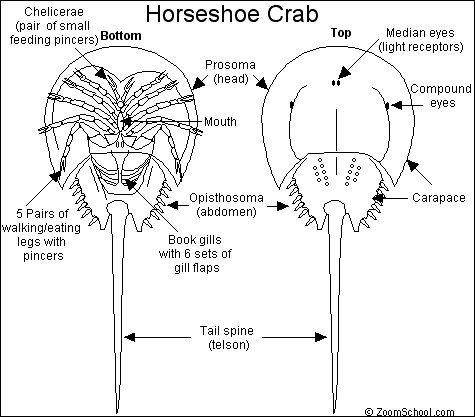
                    "Reach out and touch the top of the crab.  How does it feel?  Give it a light tap to feel how strong it is.  Now, can anyone find his eyes?  How many eyes do you think he has?"  Kids will guess low numbers like 2, 3, 4, etc.  As they go up in numbers I'll say enthusiastically, "Getting warmer!!!  Getting warmer!!!  Warmer!!!"  This back and forth antiphonal response will elevate in speed and volume until I finally break in and say, "Would you believe if I said that he has two...thousand eyes!!!"  Kids often let out a gasp of disbelief.  "Take a close look!  Each one of those eyes has almost one thousand eyes packed into it."  I ask the kids if they've ever walked by a painting and felt like the painting was watching them no matter where they were standing.  Guess what?  He has eyes like that!!!"    An appearance of a black ocular dot will appear to follow the observer.  "Why? Why do we only have two eyes that see really, really well and he has 2,000 eyes that don't see as well?"  Kids will speculate that maybe it is to see in multiple directions simultaneously.  I say that maybe we can test that!


                  "We should first test on ourselves.  Let's test our field of vision, that's the range that we can see in."  Next I ask the kids to pick out a point across the room to look at.  I tell them to fix and lock their heads and eyes on that object.  (Kids will want to cheat and move their eyes.)  I then ask them to take their hands and put them in front of of their body like they're going to give someone a big hug.  Then to take their hands and spread them eagle until they can't see their hands any more.  That is their field of vision.  Mine is about 170 degrees.  Review how many degrees a half circle is.  Then I excitedly say that we can test the field of vision of the horseshoe crab.  I then pick a volunteer across from me.  They will then need to pick one of the large eyes on top to experiment with.  I then say that if you can see the crab's eye that he can see you.  Does that make sense?  I then say that I'm going to rotate the top of the crab and that they should let me know when they start to see the eye and when they stop seeing the eye.  Having completed that I gesture with my hand and review for everyone what the volunteer stated as when they started and when they stopped seeing the eye.  Ask for an estimation of how many degrees (reviewing that a full circle is 360, half circle is 180, etc.)  Then figure out the total of both eyes combined, explaining that there will be overlap in fields of vision between the two eyes.  The crab can see in a full circle!!!  I then use examples from the kids attire:  "He can see your cool baseball cap.  He can see your purple sweater over there!  He can see your red quicksilver shirt right here!  He can see all of us at once!!  Imagine what that would feel like to see all around you at once!!!"


                  A Horseshoe Crab's Calendar and Watch


                  Inevitably, one of kids will point out the two dots on his carapace that looks like a nose.  I then ask, "Well, if that was his nose, would it be a hole or a dot?"  Kids may flounder in answering, but eventually one will realize that it would need to be holes to be a nose since air or water must circulate through it.  I then ask for them to look very closely to see which it is.  I then explain that it's another set of eyes that specialize in UV light, an invisible light to humans, and that they use that to tell what phase of the moon it is (or time of day) to synchronize their reproduction (said euphemistically, usually).


                  The Underbelly of the Great Beast


                  "Who's feeling brave today?!?!  I mean really, really, really, super, duper brave!!!    I'm going to ask you to do something really, really scary.  Like so scary that I don't think ____ grade could do it." Pick one grade below whatever the kids are.  "Here's what I'm going to ask you to do.  I'm going to flip this crab over and he has one dozen scary claws.  How many is a dozen?    If you're feeling brave, and not everyone has to do this, I want you to stick your hand in that mess of claws!!!"    The group dynamics of this are fascinating.  If the ice isn't broken by one of the kids (preferably a girl so the boys have to defend their masculinity) then I may have to demonstrate and explain that his pinchers aren't for defense like a blue crabs/stone crabs.  They're just for picking stuff up and for walking with.  Other times one of the 'cool' kids will do it and subsequently every single kid will want to.


                  The Mustache of the Great Beast

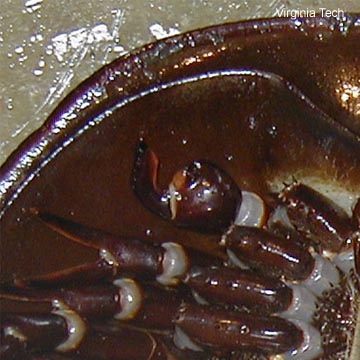
                  "Here's what I want you to do.  I'm going to flip him over again and I want you to touch his back again and while you're touching it I want you to think about this--he can't feel that.  He may not be able to feel that, but he does have a way of feeling.  What could it be?  Can anyone help me solve this mystery?  Alright, everyone stick out your arm.  Now, take your hand and very lightly touch your arm.  I know that you've done that before, but this time I want you to think about it like a scientist would.  What method does your body use to feel?  We see by our eyes letting in light and our brain interprets that light as sight, vision.  We feel by pressure.  When we touch our arm we feel an ever so slight, teeny-weeny, microscopic dent or indentation on our arm.  Does that make sense?  We feel by our soft skin being pushed on, but the crab doesn't have soft skin.  How does it feel then?  Stick your arm out again.   This time don't touch your arm, but just barely tickle the hairs on your arm.  That's how the horseshoe crab feels!  Let's flip him over again and you point out every where that he has a bunch of hairs.  Those are places that he really wants to feel!"  (Kids point out mouth area and hind quarters.)  "So, why do you think that he wants to feel so well right around here?"  (Waves finger around mouth. Kids make guesses.)  "Why does a cat or a dog have whiskers?  Well, where's his mouth?  How might a scientist make sure that's his mouth?"  It surprises me that this can be a tough question.  One right answer is to put some food there and see if it gets eaten.


                  Death by Funky Chicken


                  "The other weird thing about the horseshoe crabs mouth is that his teeth are attached to his legs!!  Who wants to be a horseshoe crab with me for a minute?"  Kids raise hands.  "We're going to do something silly.   So, how do you eat if your teeth are attached to your legs?  You do the funky chicken!!"  Kids have fun acting this out.


                  Half Billion Year Old Habits Die Hard


                  "The ancestors of the horseshoe crabs, the eurypterids, started laying eggs on the beach almost 500 million years ago.  Why?"  Wait for people to think about it.  If I'm presenting to adults I'll see if they know what was happening at the time period and whether or not the dinosaurs had arrived on the scene.  "Because there was literally nothing on the land at that time--no plants, no animals and certainly no predators.  The land was the perfect safe haven for their offspring and now they've continued that tradition for half of a billion years.  Now, more recently, it's a very important part of the diet of many migratory birds (like the endangered Red Knot that flies from Canada down to the tip of S. America yearly--9,300 miles)."


                  Blue Blood


                  "Horseshoe crabs have blue blood.  Does anyone know why our blood is red?  Iron!  Well, they have blue blood because they use copper instead of iron to carry oxygen around in their blood!"


                  Limulus Amoebocyte Lysate


                  "Who has gotten an immunization or flue shot recently?  Did you know that those shots get tested with a compound from horseshoe crabs?!  It's true!  Because the environment the horseshoe crabs live in isn't exactly the cleanest--it can have billions of bacteria per gram of mud--they have very special adaptations to deal with the bacteria.  One of which is that their blood has a compound, Limulus amoebocyte lysate, that coagulates in the presence of gram-negative bacteria (the kind we need to worry about the most for infections).  The government requires that medical companies test their shots with this compound and if they put into the sample and it coagulates they know the batch is contaminated and they know to throw it out.  Your life could have been saved by a horseshoe crab and you didn't eve know it!!"

                  Male 'boxing glove' claw used to hold on to female's carapace.


                  Boys vs. Girls


                  (Hold up crab.)  "Is this a boy horseshoe crab or a girl?"  (Kids will never not answer.  Funny to think about how ingrained gender is into our psyches, even at a young age.  Flip crab over after taking vote.)  "Here's how we tell: the males crabs have a 'boxing glove' pincher that they use to hold onto the backs of of the females (right next to the base of the tail).  Females have all the same kind of claws."


                  Snow Shoes

                  "What do you think these weird flower feet are for?"  Pause for guesses.  Allow the kids to speculate.  "Pushing on soft mud.  There is also a tiny claw on that leg that is specific for cleaning the gills.  His underside is kind of a Swiss army knife of tools!"


                  All Booked Up


                  Point out book gills.   "Why do you think they're called book gills?"  Wait for guesses.  "Because the individual flaps look like the pages of a book!"


                  Fed Up


                  (This is acted out dramatically.)  "Here's how the horseshoe crab eats.  He takes his big head and then rams it into the mud.  Then he takes all those pinchers and starts ramming them into the mud to find anything he can get--worms, clams, crustaceans, etc. and then pulverizes them with his leg-teeth."


                  O-So Hungry


                  "What's the longest you've gone without eating?"  Kids may say a day or most of a day.  "Guess how long a horseshoe crab can go without  eating?  Some sources say up to a year!"

                  Flabellum


                  "This tiny, insignificant little flap has a very important use.  It has over 1 million chemical sensors and can be used to detect carbon dioxide so as to let the crab know when he ought to move out of stagnant water."  (Flabellum means tiny fan in Latin and in Roman Catholicism it is the name of the tiny fan used to shew flies away from the Sacraments.)


                  Spines - Why Science Is Still Cool


                  "What do you think these move-able spines are for?"  Pause for kids to process out loud.  "Maybe you're right!  I have been told that scientists aren't sure the exact function of them.  I love that fact.  Do you know why?  I love it that there is still so much to learn!  I love that maybe you can grow up, become a scientist and help to solve some of these mysteries!!"


                    Pictures from here, here, hereherehere, here, here, here, here, here, here, here, here, here, here, here, here, here, here and here.


                  Works sighted [sic]:


                  http://en.wikipedia.org/wiki/Horseshoe_crab
                  http://www.beach-net.com/horseshoe/Bayhorsecrab.html
                  http://horseshoecrab.org/
                  http://www.ceoe.udel.edu/horseshoecrab/
                  http://www.dnr.state.md.us/education/horseshoecrab/
                  http://www.arkive.org/horseshoe-crab/limulus-polyphemus/
                  http://seagrant.gso.uri.edu/factsheets/horseshoe_crab.html
                  http://horseshoe-crabs.com/
                  http://www.oar.noaa.gov/spotlite/archive/spot_delaware.html